Plywood vs MDF vs HDHMR: Which Is Best for Home Interiors in Bengaluru?
By Vishwanath, Founder and Chief Architect, Nisarga Construction
Planning your home interiors and confused between plywood, MDF and HDHMR? Understand how these materials differ, where each one works best, and what you should choose for your modular kitchen, wardrobes and furniture.
When you start planning your home interiors, one of the first things your interior designer will discuss is the material to be used for your cabinets, wardrobes, kitchen and furniture.
You will probably hear three names quite often: plywood, MDF and HDHMR.
At first, they may all seem like different versions of the same thing. They are not.
Each material is manufactured differently, has its own strengths and limitations, and performs differently depending on where it is used. Choosing the wrong one can lead to problems such as swelling, damaged edges, loose fittings or reduced durability.
So, which is better: plywood, MDF or HDHMR?
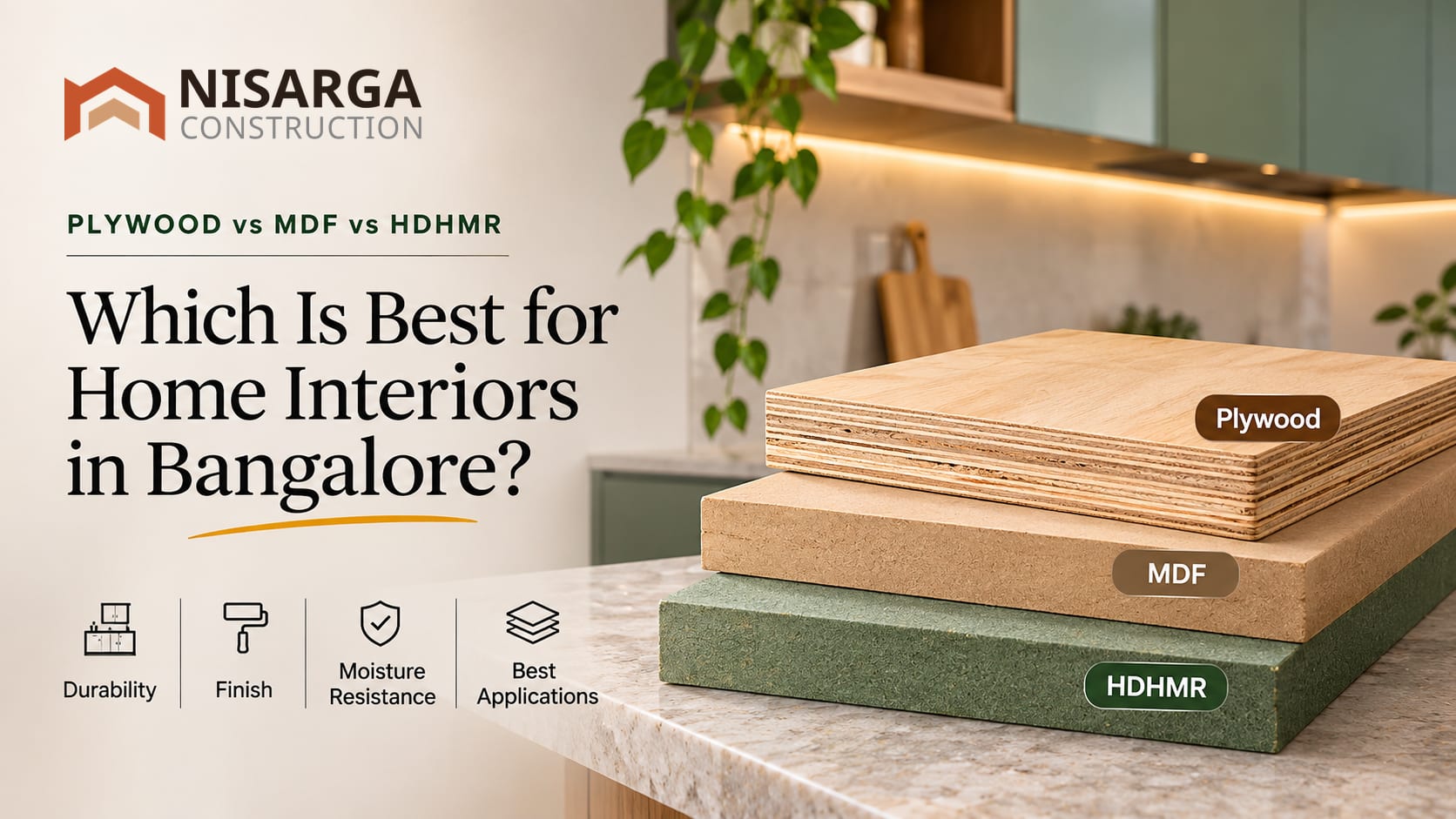
The answer depends on what you are making. Plywood is generally a strong choice for structural furniture and cabinet carcasses. MDF works well for smooth decorative surfaces and designs that require detailed machining. HDHMR can be useful for selected furniture applications where a dense board with improved moisture resistance is required. However, none of these should be treated as automatically waterproof.
At Nisarga Construction, we believe material selection should be based on how a family actually uses its home, not simply on which board is being promoted as the latest or most premium option.
Let's understand the differences before you make that decision.
1. What Is Plywood?
Plywood is an engineered wood product made by bonding multiple thin layers of wood veneer together. The direction of the wood grain is generally alternated between layers to improve strength and dimensional stability.
This layered construction makes plywood suitable for furniture and applications where the board needs to handle weight, fittings and everyday use.
You will commonly find plywood in:
Modular kitchen cabinets.
Wardrobe carcasses.
Bed frames and storage beds.
TV units.
Bookshelves.
Study tables.
Storage cabinets.
Custom furniture.
What are the different types of plywood?
You may come across different plywood grades while discussing your interiors.
MR plywood: Moisture-resistant plywood, generally used in interior applications that are not exposed to significant water or prolonged moisture.
BWR plywood: Boiling Water Resistant plywood, intended for applications requiring greater resistance to moisture than MR-grade plywood.
BWP plywood: Boiling Water Proof plywood, a designation used for plywood intended for more demanding moisture exposure.
Marine plywood: A product specified under IS 710. It is manufactured and tested for demanding moisture and marine applications.
These terms are not interchangeable. Marine plywood should not be selected merely because a salesperson calls a board waterproof. Ask for its actual specification and relevant certification.
The Bureau of Indian Standards has published the revised IS 303:2024 for general-purpose plywood and IS 710:2024 for marine plywood.
Advantages of plywood
Good strength for furniture and cabinet construction.
Generally good screw-holding performance.
Available in different grades and thicknesses.
Suitable for a wide range of furniture applications.
Can be finished with laminates, veneers and other decorative surfaces.
Offers flexibility for customised furniture.
Limitations of plywood
Not all plywood is manufactured to the same quality.
Poor-quality boards may contain internal gaps, uneven layers or weak bonding. Exposure to water can also damage unsuitable plywood, particularly when the edges are left unsealed.
The quality of the timber veneers, adhesive, manufacturing process and grade makes a considerable difference.
My recommendation: Do not buy plywood simply because it is labelled BWR, BWP or marine. Verify the manufacturer's technical specifications, applicable standard, thickness and intended application.
2. What Is MDF?
MDF stands for Medium Density Fibreboard.
Unlike plywood, which is made from layers of wood veneer, MDF is manufactured using fine wood fibres combined with resin and compressed under controlled heat and pressure.
The result is a dense board with a smooth and consistent surface.
This makes MDF particularly useful when the design requires clean surfaces, painted finishes or decorative details.
You will commonly find MDF in:
Decorative wall panelling.
TV unit back panels.
Painted wardrobe shutters.
Decorative furniture.
CNC-cut designs.
Moulded and routed panels.
Selected shelves and display units.
Why do interior designers use MDF?
One of MDF's biggest advantages is its smooth surface.
It does not have the visible wood grain or natural veneer variations found in plywood. This makes it useful when you want a uniform painted or decorative finish.
MDF can also be machined into detailed patterns and profiles.
For example, if you want a wardrobe with routed grooves, decorative panel designs or a clean painted finish, MDF can be considered for the appropriate application.
Advantages of MDF
Smooth and consistent surface.
Suitable for painted finishes.
Useful for decorative and CNC-routed designs.
No natural wood grain to work around.
Uniform board structure.
Can be a practical choice for selected decorative furniture.
Smooth and consistent surface.
Suitable for painted finishes.
Useful for decorative and CNC-routed designs.
No natural wood grain to work around.
Uniform board structure.
Can be a practical choice for selected decorative furniture.
Limitations of MDF
Standard MDF is not a suitable choice for locations with frequent water exposure.
If moisture enters the board, it can swell and lose its original shape. Damaged edges can be particularly difficult to repair.
MDF can also be heavier than some plywood options of similar dimensions. Its screw-holding performance, especially at the edges, needs to be considered when designing furniture.
There are moisture-resistant MDF grades available, but a moisture-resistant specification should not be confused with waterproof performance.
My recommendation: MDF is worth considering for decorative work, painted shutters and wall panels in suitable interior conditions. I would be much more careful about specifying it for kitchen carcasses, sink cabinets or other locations exposed to water.
3. What Is HDHMR?
HDHMR stands for High Density High Moisture Resistant.
It is commonly marketed as a high-density engineered fibreboard designed to offer improved moisture resistance compared with ordinary MDF.
Like MDF, it is made using wood fibres and resin. However, the density and manufacturing characteristics differ depending on the product.
HDHMR has become popular in home interiors because it offers a combination of a relatively smooth surface, machining flexibility and improved moisture performance in selected applications.
It is commonly considered for:
Kitchen shutters.
Wardrobe shutters.
Decorative wall panels.
Furniture panels.
CNC-routed designs.
Selected storage units.
Why is HDHMR becoming popular?
Many homeowners want a smooth finish but are concerned about using standard MDF in areas where humidity or occasional splashes may be present.
This is where HDHMR enters the discussion.
Depending on the manufacturer's tested specifications, it may offer better resistance to moisture than standard MDF.
It can also be machined for certain decorative designs and customised furniture.
Advantages of HDHMR
Dense and relatively uniform board structure.
Smooth surface suitable for decorative finishes.
Suitable for selected CNC-routed designs.
Improved moisture-resistance options compared with standard MDF.
Can be considered for certain kitchen and wardrobe applications.
Useful where consistent surface finishing is important.
Limitations of HDHMR
There is something important homeowners should understand.
HDHMR does not mean waterproof.
Even a board marketed as moisture-resistant can be damaged by prolonged water exposure, leakage or poorly sealed edges.
HDHMR boards are also relatively heavy, and their screw-holding performance, edge strength and moisture behaviour depend on the manufacturer's specifications.
The term HDHMR alone does not tell you everything about the board's quality.
Ask for the actual product specification, test information, applicable Indian Standard classification and manufacturer documentation.
4. Plywood vs MDF vs HDHMR: What Is the Difference?
Here is a practical comparison of the three materials.
| Feature | Plywood | MDF | HDHMR |
|---|---|---|---|
| Manufacturing | Layers of wood veneer | Compressed wood fibres | High-density engineered fibreboard |
| Structure | Layered | Uniform fibre structure | Dense fibre structure |
| Surface | Depends on veneer quality | Smooth and consistent | Smooth and consistent |
| Strength | Generally suitable for structural furniture | Suitable for selected furniture and decorative use | Suitable for selected furniture applications |
| Screw holding | Generally good | Depends on density and fixing method | Product-dependent |
| Moisture resistance | Depends on plywood grade | Depends on MDF grade | Depends on product specification |
| Decorative routing | Possible | Very suitable | Very suitable |
| Painted finishes | Suitable with preparation | Very suitable | Suitable |
| Typical applications | Cabinets, wardrobes, beds and furniture | Panels, painted surfaces and decorative work | Selected shutters, panels and furniture |
This table is a general guide. Actual performance depends on board quality, grade, thickness, manufacturer, installation and exposure conditions.
5. Which Is Best for Modular Kitchen Cabinets?
The kitchen is one of the areas where material selection deserves particular attention.
Think about what your kitchen goes through every day: cooking, steam, occasional spills, cleaning, plumbing connections, heavy utensils and frequent opening and closing of cabinet doors.
Different parts of the kitchen experience different conditions. It does not make sense to choose the same board for everything.
Kitchen carcass
The carcass is the main cabinet structure that supports the shutters, shelves and storage.
For kitchen carcasses, suitable plywood grades are commonly preferred because of their strength and furniture-fixing performance.
The board grade should be selected according to the location and expected moisture exposure.
Sink cabinet
The area below the kitchen sink deserves special attention.
It is more vulnerable to plumbing leaks, splashes and standing water than most other kitchen cabinets.
A suitably specified high-moisture-grade plywood, appropriate sealing and proper plumbing protection should be considered here.
No board should be treated as a substitute for fixing leaks or protecting the cabinet from water.
Kitchen shutters
For shutters, HDHMR or moisture-resistant MDF may be considered depending on the finish, design and manufacturer's specifications.
For example, an HDHMR shutter may be suitable for a particular painted or routed design, while another kitchen may benefit from a different board and finish combination.
Kitchen lofts and overhead cabinets
The choice depends on the expected load, cabinet design, board thickness and fixing arrangement.
Do not compromise on the structural requirements simply because the cabinet is not directly exposed to water.
Our approach: Select materials according to the role of each kitchen component. The cabinet carcass, shutters, shelves and sink unit do not necessarily need to use the same board.
6. Which Material Is Best for Wardrobes?
Wardrobes are different from kitchen cabinets.
They are generally exposed to less direct water, but they need to support clothing, accessories, drawers, shelves and frequently used shutters.
Here is how I would approach the selection.
Wardrobe carcass
Plywood is a commonly preferred option for wardrobe carcasses because of its strength and suitability for fixed furniture construction.
It works well for shelves, internal partitions and storage structures when the correct thickness and support arrangement are used.
Wardrobe shutters
HDHMR and MDF can both be considered for wardrobe shutters, especially when the design requires painted finishes, decorative routing or a smooth surface.
Plywood is also suitable, particularly where the preferred finish involves laminate or veneer.
Internal shelves and drawers
The material should be selected according to the expected load, shelf span, thickness and type of fixing.
Heavy storage shelves need proper support regardless of the board selected.
A wardrobe should be designed around what you intend to store, not just how it looks from outside.
7. Which Material Should You Use for TV Units and Decorative Wall Panels?
This is where MDF and HDHMR can offer good design flexibility.
If you want a TV backdrop with decorative grooves, routed patterns or painted finishes, MDF can be a practical choice in dry interior conditions.
HDHMR may be considered where the design needs a denser board or improved moisture resistance according to the product specification.
Plywood is also useful when the design includes storage cabinets, floating shelves or furniture that needs to support heavier loads.
For a typical TV unit, different materials can be used for different components:
Structural storage cabinets: suitable plywood or an engineered board specified for the required load.
Decorative wall panels: MDF or HDHMR, depending on the environment and finish.
Floating shelves: material and support designed around the expected weight.
Painted routed panels: MDF or HDHMR, depending on the product and application.
The final design should consider the weight of the television, accessories, storage requirements and wall fixing arrangement.
8. Can Plywood, MDF and HDHMR Be Used in Bathrooms?
This is a question homeowners should take seriously.
Bathrooms have a much higher risk of moisture exposure than most other rooms.
Water can reach furniture through splashing, plumbing leaks, wet floors and poor ventilation.
Standard MDF should generally be avoided in locations where it may repeatedly get wet.
Moisture-resistant MDF and HDHMR may have specific applications in suitable conditions, but neither should automatically be treated as waterproof.
Plywood must also be selected according to the grade and exposure conditions.
For bathroom vanities and storage, the designer should consider:
Actual water exposure.
Suitable board grade.
Edge sealing.
Surface finishing.
Waterproofing around the installation.
Plumbing access.
Ventilation.
The possibility of leakage.
In some bathrooms, a more water-resistant material or non-wood alternative may be more appropriate.
Remember that the entire assembly matters. Even a suitably specified board can fail if water enters through an exposed edge, damaged laminate or an untreated cut-out.
9. Does Bangalore's Climate Affect Your Material Selection?
Yes, but the decision should be based on the conditions inside your home rather than simply the city's name.
Bangalore homes can experience moisture-related issues from kitchen steam, bathroom use, plumbing leaks, monsoon conditions, balconies and poorly ventilated storage areas.
For homeowners in Bengaluru and other parts of Karnataka, the important question is where the furniture will be installed and what kind of moisture it is likely to encounter.
For example:
A bedroom wardrobe in a dry, ventilated room has different requirements from a kitchen sink cabinet.
A decorative TV panel has different requirements from a storage unit close to a water source.
A bathroom vanity needs more careful material and edge protection than a living-room display shelf.
The material should be selected for its actual application.
Do not pay extra for a moisture-resistant board everywhere when the application does not require it. At the same time, do not cut corners in areas where moisture exposure is a real concern.
10. How to Check the Quality Before Buying Interior Boards
This is where homeowners should spend a little more time.
Two boards carrying similar product descriptions may not necessarily offer the same performance.
Before approving the material, ask your interior designer or contractor the following questions.
Check the manufacturer's specifications
Find out the manufacturer, product name, grade, thickness and intended application.
Do not accept only a verbal statement that the material is premium quality.
Ask about the applicable BIS standard
For plywood, check the applicable standard and grade.
Relevant Indian standards include:
IS 303:2024 for plywood for general purposes.
IS 710:2024 for marine plywood.
For MDF, IS 12406:2025 covers medium-density fibreboards for general-purpose applications and specifies categories including regular, MR and HMR grades.
For a board marketed as HDHMR, ask which tested grade and product specification it actually meets. Do not assume that the HDHMR name alone establishes its certification.
Check formaldehyde information
Engineered wood boards use adhesives and resins.
Ask the supplier for the applicable formaldehyde classification and supporting product documentation.
Where available, look for the relevant E1 or E2 classification. Do not assume that all engineered boards have identical emission performance.
Check the board edges
Look for:
Uniform thickness.
Clean, undamaged edges.
Consistent internal construction.
No obvious swelling or delamination.
Proper storage and handling.
A visual inspection cannot replace technical testing, but it can help identify obvious defects.
Check edge sealing and finishing
Board edges need proper treatment according to the material and installation.
Cut edges, screw holes and plumbing cut-outs are common points where moisture can enter.
Make sure the finishing and installation details are included in the design and quotation.
11. Common Mistakes Homeowners Make When Selecting Interior Materials
Over the years, one of the things I would encourage homeowners to avoid is choosing materials based only on what sounds premium.
Here are some common mistakes.
Choosing one material for the entire house: Different rooms and furniture components have different requirements. The kitchen, wardrobe and decorative wall panel do not need identical materials.
Assuming HDHMR is waterproof: Moisture resistance and waterproofing are not the same thing.
Selecting boards without checking their specifications: A product name alone is not enough. Ask for the technical details.
Ignoring board thickness: Material thickness should suit the furniture dimensions, support and expected load.
Ignoring hardware quality: Hinges, drawer channels, fasteners and installation methods influence how well furniture performs.
Not checking edge treatment: Exposed edges and cut-outs can become vulnerable points.
Comparing only the overall quotation: Two interior quotations may use different materials and specifications, even when the furniture looks similar in the design presentation.
Ignoring future maintenance: Choose finishes and materials that you can maintain comfortably over time.
12. Questions to Ask Your Interior Designer Before Finalising Materials
Before signing off on your interior design quotation, ask these questions:
Which material is being used for each cabinet and furniture component?
What is the manufacturer and exact product specification?
What grade of plywood or MDF is proposed?
What is the thickness of each board?
What is the moisture-resistance specification?
Is the material certified to the relevant Indian Standard, where applicable?
What formaldehyde classification is available?
How will the edges and cut-outs be sealed?
Which hardware brands and specifications are included?
Are these specifications documented in the quotation?
Ask for a material schedule that explains what is being used in each room.
This makes it easier to compare quotations and reduces the possibility of material substitutions without your knowledge.
13. So, Which Material Would I Choose for a Home Interior?
There is no single winner.
If I were planning a home interior, I would select materials according to the purpose of each component rather than insisting that every cabinet use one type of board.
Here is the practical way to look at it:
| Home interior requirement | Material worth considering |
|---|---|
| Kitchen cabinet carcass | Suitable moisture-grade plywood |
| Under-sink cabinet | Appropriately specified high-moisture-grade plywood with proper protection |
| Kitchen shutters | HDHMR, moisture-resistant MDF or plywood, depending on finish and specification |
| Wardrobe carcass | Plywood or another appropriately specified engineered board |
| Painted wardrobe shutters | MDF or HDHMR, depending on the application |
| Decorative wall panelling | MDF or HDHMR |
| CNC-routed panels | MDF or HDHMR, depending on the design and location |
| Heavy-duty storage shelves | Suitable plywood or a board engineered for the expected load |
| Bathroom vanity | Material specifically suitable for the water exposure, with proper sealing and installation |
The final selection should always be confirmed against the manufacturer's technical data and the actual design requirements.
14. How Nisarga Approaches Material Selection for Home Interiors
At Nisarga Construction, we believe an interior should look good, feel comfortable and work well for everyday living.
A kitchen used by a family that cooks frequently has different requirements from a guest bedroom wardrobe. Similarly, a decorative wall panel does not need the same material specifications as a cabinet designed to carry heavy storage.
That is why material selection should happen during the design and detailing stage, not after the quotation is finalised.
Our approach is to understand:
How the homeowner uses each room.
What kind of storage is required.
Which finishes the homeowner prefers.
The expected durability and maintenance requirements.
Where moisture or heat exposure may occur.
What material specifications are appropriate for each component.
We believe homeowners should understand what is going into their homes.
Whether you are planning a modular kitchen, complete 2BHK or 3BHK interiors, a luxury villa or a renovation, the material selection should be part of a properly planned design.
We work with homeowners in Bengaluru and undertake suitable construction and interior design projects across Karnataka.
Final Thoughts: Choose the Right Material, Not Just the Most Expensive One
Plywood, MDF and HDHMR all have a place in modern home interiors.
Plywood is a strong option for many furniture and cabinet structures. MDF offers excellent flexibility for smooth decorative and painted finishes. HDHMR provides another option for selected applications where its density and tested moisture-resistance properties are useful.
But no material is automatically right for every part of your house.
The best decision comes from understanding how each board is manufactured, where it will be installed, what kind of exposure it will face and how it will be finished.
Before finalising your interiors, ask for the exact material specifications and make sure they are documented in your quotation.
A beautiful interior is important. A well-planned interior that continues to function properly for years is even more important.
Planning your home interiors in Bangalore or elsewhere in Karnataka?
Talk to Nisarga Construction about your requirements.
Nisarga Construction
Building Homes. Creating Memories.
Phone: +91 90085 04567 / +91 86182 78754
Get your quote now : Link
Discuss your interior design plans with our team and arrange a site visit.